
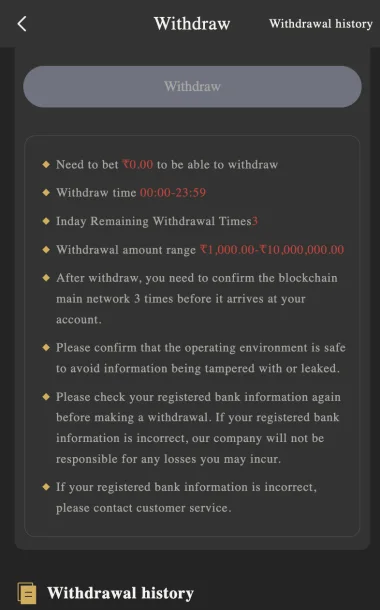
Understand what the account is recording
A withdrawal history usually records a request to move an account balance elsewhere. The request may pass through several internal states before a payment is attempted. An account label can describe that internal process without describing a completed bank transfer. Read the wording attached to the entry rather than assuming that every label has a universal banking meaning.
Start with one request at a time. Note its date, amount, identifier and current status. If there are several requests, keep a separate record for each. Combining them into one total may hide the fact that one was rejected, another remains pending and a third has a matching bank credit. Separate rows make the facts easier to check.
Do not treat a visible balance as cash already held in your bank. A balance is information displayed by the service. Whether it represents an amount legally payable, whether conditions apply and whether a transfer has been made are separate questions that require evidence. An article cannot settle those questions simply by describing the interface.
Distinguish requested, reviewed, rejected and paid
A requested or submitted status generally describes an entry being created. A review label suggests the service has not yet presented a final outcome. A rejected or cancelled label indicates that the particular request did not proceed as originally entered, but you still need to understand what happened to the associated balance. A paid or completed label calls for a matching payment record, not an assumption.
These descriptions explain ordinary account terminology. They are not verified definitions of a current BDG Win policy. If the wording in your account differs, quote it exactly when asking for help. A clear question might ask whether completed means an internal approval or an external transfer, and request the reference needed to identify any claimed payment.
Avoid translating every delay into the same diagnosis. A missing bank credit, a rejected request and an inaccessible account are different problems. Each needs different evidence. Using the precise status in a complaint makes it easier for a responsible team to explain the next step and harder for an unrelated contact to distract you with a generic promise.
Check the receiving bank independently
Open the receiving bank account through your normal bank app or website. Review the transaction history around the relevant date and amount. Do not rely only on the total balance, because other payments may have changed it. If a credit appears, inspect its details and preserve the reference before assuming it corresponds to the withdrawal request.
A name in a bank statement may differ from the brand name shown in an account. This does not by itself explain the relationship between the sender and the service. Ask for clarification when the connection is uncertain. A matching amount can be useful, but it is stronger when paired with a payment reference and a date that fits the request.
If the service says it transferred funds, request the payment method, transfer date and traceable reference through a verified support route. You can then ask the bank what it can establish from that information. A bank cannot investigate an unnamed transfer with no useful identifiers merely because a website says that a request is complete.
Create a withdrawal evidence file
Keep the account request entry, its identifier, the displayed status and any explanation attached to it. Add the receiving bank history needed to show whether a matching credit is present. Preserve support messages with dates and the complaint reference. The purpose is to make the sequence understandable, not to collect every unrelated part of the account.
Store original records privately and send redacted copies when possible. Remove full bank account numbers, unrelated transactions, available balances, authentication codes and personal notifications. Never provide an account password or a UPI PIN as evidence. Those secrets authorise access or payment; they are not necessary to describe a disputed withdrawal.
A filename containing the date and a short description can prevent confusion later. Keep separate copies of the initial status and any later change. If a request disappears from history, your earlier record may still be useful. Do not alter the original image to add explanatory text; put your explanation in a separate note so the source record remains intact.
Ask what a pending withdrawal is waiting for
Pending is an incomplete answer. A useful response should say what remains outstanding, which organisation is responsible for the next action and whether anything specific is required from you. If the answer only repeats that processing is underway, ask for a reference and an explanation that relates to the particular request.
Do not invent a deadline from other users' posts. Two accounts may involve different payment methods, dates, review circumstances or even different operators using a similar brand. A claim that one person received a payment quickly cannot establish the policy for another request. We do not publish a universal waiting time without a verified current source.
Record the last meaningful update and the action it described. Repeatedly asking the same question in new chats can create several disconnected conversations. A focused follow-up can quote the original request ID and ask whether the stated action has occurred. If no clear response is available, preserve that fact and consider the formal complaint routes relevant to the payment or suspected misconduct.
What to clarify when a request is rejected
A rejection should be explained in terms you can understand. Ask for the specific reason, the relevant written policy and what happened to the amount associated with the request. A message that says wrong details is incomplete unless it identifies which detail needs correction through a secure process. Do not guess or repeatedly resubmit while the reason remains unclear.
If the issue concerns a receiving account, avoid sending complete bank details in an open group. Use the organisation's authenticated route and confirm why the information is needed. If the service requests identity documents, check the recipient, privacy information and submission method before sending them. A private document should not be handed to an unknown chat contact who claims to be a shortcut to approval.
A rejected request is also different from a bank rejection of an actual transfer. Ask which event occurred. If a bank transfer was attempted, request its traceable reference. If no payment was attempted, the account service needs to explain the internal decision rather than directing you to your bank without any transfer information.
When the account says completed but the bank shows no credit
Write down the precise mismatch: the account status is completed, the service has or has not provided a payment reference, and the receiving bank history does not show a matching credit. This wording is stronger than saying the money vanished. It separates what you can observe from what still needs investigation.
Request the transfer date, payment method, amount and reference. Ask whether the status refers to an actual external payment or an internal approval. If the service provides a document, examine the phone number or emails and recipient details without assuming the document itself proves settlement. A bank record remains an independent source for whether the receiving account was credited.
Contact the receiving bank through its established channel with the information available. Be clear that you are enquiring about an expected incoming payment. Do not classify a missing incoming credit as an unauthorised debit unless your bank records actually show such a debit. Accurate complaint categories make the financial issue easier to understand and reduce unnecessary back-and-forth.
Keep withdrawal conditions separate from promotional wording
A promotional balance, account balance and withdrawable amount may be different figures. If an offer uses words such as bonus, reward, cash or credit, read the definitions attached to that offer. A large number in a banner does not establish that the same amount can be transferred to a bank. The relevant conditions should explain the relationship clearly.
Ask for the exact policy that applied when the balance was recorded. Preserve the version you were shown if it is available. Do not rely on a later chat summary that changes the explanation without identifying the underlying terms. If two explanations conflict, quote both and ask the responsible organisation to resolve the inconsistency in writing.
We have not verified a current BDG Win minimum withdrawal, maximum withdrawal, fee, bonus conversion rule or payment schedule. Publishing guessed numbers would make the article look decisive while leaving readers with unreliable information. The useful question is what the service can substantiate about your particular request, not which unverified number appears most often in search results.
Do not pay to unlock a withdrawal
A request for an extra payment deserves careful scrutiny, especially when the sender says it will release a larger balance. The label may be verification, security, tax clearance, account upgrade or a refundable deposit. The name does not explain why a new transfer is necessary or establish that the person asking is authorised.
Do not send money simply because a countdown or chat message says the balance will be lost otherwise. Ask for a written explanation and verify any claimed legal or banking requirement independently. A personal account number sent in a chat is not proof of a legitimate charge. Nor is a document made to resemble a bank receipt or government notice.
If you suspect financial fraud, contact your bank promptly and use the National Cybercrime Reporting Portal or 1930 in India. Keep messages, recipient details and transaction references. Reporting helps create an official record but does not guarantee recovery. Be wary of people who contact you afterwards and promise to retrieve funds for an advance fee.
Verify who is answering a support request
A support name, profile photograph or Telegram handle can be copied. Start with the contact route published by the organisation you are actually dealing with and check its connection to your account. A forwarded number from another user is weaker evidence. If the service changes a contact address, seek confirmation through an existing trusted route before sharing anything sensitive.
Ask the representative to attach the conversation to a complaint reference. Keep the written reply and note which channel it came through. An answer that refuses to provide any case identifier but demands immediate payment should not be treated as a reliable investigation. Equally, a friendly tone does not establish authority to access or alter an account.
The Telegram link on an independent publication is not automatically the operator's support desk. A community or publisher channel may discuss articles and announcements without having access to transaction systems. Before sending a private financial issue, establish who runs the channel, what it can actually do and whether there is a safer formal route.
Write a support message that can be investigated
Begin with one clear sentence: a withdrawal request with a stated identifier has a stated status, but the receiving bank has no matching credit. Add the request date, amount and any payment reference provided. Then ask a specific question, such as whether a transfer was sent and which reference the bank can trace.
Avoid including a long account history unless it is relevant. A short factual message with two useful attachments is easier to investigate than many screenshots with no explanation. If the issue includes more than one request, number them and list each separately. State what outcome you need clarified rather than assuming a representative knows the background from earlier chats.
For a follow-up, quote the existing complaint reference and the last promised action. Ask whether that action has occurred and request the next written update. Keep the thread intact. If you escalate to another organisation, explain which part of the issue belongs to it. The bank can examine bank records; an account service must explain its own ledger and status labels.
Handle identity and bank-detail requests carefully
Some services may request identity or account verification, but that does not make every request appropriate. Confirm the recipient and the reason before providing documents. Read the privacy information and use a secure submission route. Do not send an unredacted identity document to an unsolicited contact simply because the person knows your account name.
Where a document is genuinely required, ask what information must remain visible and how it will be used. Keep a note of what you sent, when and through which channel. Avoid distributing the same document to several contacts in an attempt to speed up a response. Each additional recipient increases the number of places where personal information may be stored.
Never share an OTP, password, UPI PIN or remote access to your phone. A legitimate need to identify an account does not require another person to control your device or approve payments on your behalf. If you have already shared access login details, secure the affected accounts through their normal recovery routes and inform the relevant bank when financial access may be involved.
Resolve account access without losing the payment record
If you cannot log in, preserve the bank history and any earlier account records first. An access problem does not stop you documenting an expected payment. Explain to support that the account cannot be opened and that you need a written record of the specific withdrawal request. Do not assume a newly suggested domain belongs to the same organisation.
Use established recovery options and avoid repeated password guesses. Keep the exact error message and the time it appeared. If the account was accessed from an unfamiliar device, note that separately from the withdrawal issue. An unexpected login notification may require a security response even when the payment question remains unresolved.
After access is restored, compare the current history with the records you retained. Note any changed status, missing request or revised amount. Ask for an explanation of differences rather than rewriting your earlier notes. A consistent evidence trail is valuable precisely because an account display can change over time, while your original observation remains part of the chronology.
Know the limits of an independent publication
BDG Win APK publishes explanatory articles. Rohit Kumar and this website cannot approve a withdrawal, contact a bank on your behalf, change an account balance or verify a private transfer from an identifier sent by email. Editorial help and account support are different services. The distinction matters when readers are worried about money and looking for someone to act quickly.
For a correction to this article, email [email protected] with the page address and the wording that needs attention. Do not attach identity documents, a full bank statement or account login details. A cropped example of changed terminology can be enough to explain an editorial issue without exposing your private financial position.
For an unresolved payment, keep working through the bank, payment provider or verified organisation responsible for the relevant record. For suspected cybercrime, use the official reporting route. A publisher email can receive feedback about a page, but sending a financial complaint there does not submit it to a bank, regulator, police service or gaming operator.
Describe the outstanding question in one sentence
Before sending a follow-up, try to state the unresolved issue in one sentence. For example, the account marks a particular request as paid, but no transfer reference has been provided and the receiving bank shows no matching credit. That sentence identifies two missing pieces of evidence without guessing where the problem occurred. It also helps you decide which organisation should answer next.
If the answer is that a request was rejected, your next question may concern the reason and the resulting account balance. If a transfer reference exists, your next question may concern what the receiving bank can trace. If you cannot access the history, your next question may concern obtaining a copy of the request record. These are different tasks, so they should not be collapsed into a general demand for a faster withdrawal.
Keep that sentence at the top of your private case notes and revise it only when new evidence changes the situation. The earlier versions can remain below it with their dates. This gives you a concise current summary and a complete history. It also reduces the temptation to send every attachment again, especially when some attachments contain private information that the recipient does not need.
Finish with an outcome you can verify
A useful outcome is something you can identify: a matching bank credit, a documented reversal, a written explanation of a rejected request or a formal complaint that remains open with a clear next step. A vague assurance that everything is fine does not answer an unresolved discrepancy. Ask for the missing fact rather than accepting a reassuring phrase alone.
Keep the final response with the original request record. If the issue is resolved, note the date and the evidence that supports that conclusion. If it remains unresolved, write a brief summary of what is still missing. This helps you avoid reopening the entire story whenever a new person reviews the case.
Finally, separate recovery of an existing issue from future activity. A resolved transfer does not certify every other claim made by a service, and a single payment experience does not establish a general policy. Read the India context and any current written terms independently. The purpose of this page is to improve understanding of records and support, not to turn uncertainty about a withdrawal into a reason to risk more money.
Frequently asked questions
Does completed mean the withdrawal reached my bank?
It may describe an internal status. Look for a matching bank credit and ask for a traceable transfer reference if the two records do not match.
What is the current BDG Win withdrawal minimum?
We have not verified a current minimum, fee or processing schedule. Do not rely on guessed figures; request the applicable written policy from the responsible organisation.
Should I pay an extra fee to release a pending balance?
Do not send an additional payment merely because a chat contact says it will unlock funds. Verify the basis independently and contact your bank if you suspect fraud.
Can Rohit Kumar resolve my account withdrawal?
No. Rohit is the publisher of this independent website and does not have access to operator accounts or banking systems.
What should I retain if support stops responding?
Keep the request ID, dated status records, bank history, complaint references and relevant messages. Redact private information in shared copies and use the official routes relevant to the issue.