
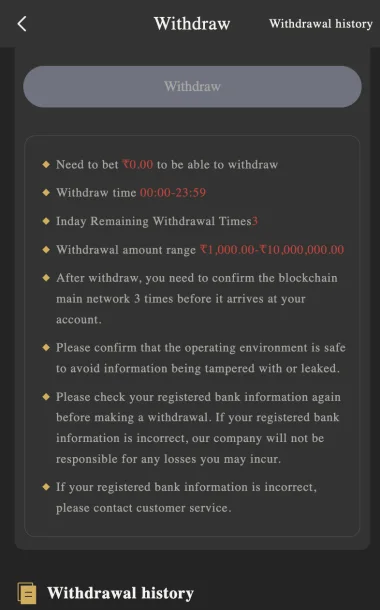
Identify what was rejected
Begin with the record, not the assumed reason. A withdrawal request can be rejected inside an account before any bank transfer is attempted. A bank can also reject a transfer after an external payment attempt. Those are different events and require different evidence. Ask which one the status describes.
Record the request ID, date, amount and exact wording. Keep any explanation shown next to the entry. If there is no explanation, say that in your enquiry. Do not infer a rule from the colour of the status badge or from another user's experience. A similar-looking message can appear in different circumstances.
If the account contains several requests, isolate the rejected one. Another request marked pending or completed does not automatically explain it. Use a separate row for each request and keep the account amount attached to the correct identifier. This prevents a review from being distracted by an unrelated transaction or an amount that happens to be the same.
Ask for the precise reason in writing
A useful reason identifies the issue and the evidence behind the decision. Wrong details, system issue or policy are starting labels rather than complete explanations. Ask which detail, which system event or which published condition applies. You do not have to guess the missing explanation yourself.
Keep the question neutral and specific. For example, ask whether the rejection occurred before a payment attempt and request the applicable written reason. If a representative mentions a condition, ask for the condition's location and version. This is more useful than asking whether the service is good or bad, because it directs attention to the decision that needs review.
Preserve the answer with the request entry. If the reason later changes, retain both versions and ask what new information caused the change. A clear review record should distinguish an initial automated label from a later investigation. Do not edit your earlier notes to make the sequence appear simpler than it was; the sequence may be important to understanding the outcome.
Establish whether an external transfer was attempted
Ask whether the request was stopped internally or whether funds were sent to a payment system and then returned or rejected. If a transfer was attempted, request the date, method, amount and traceable reference. If no transfer was attempted, a bank may have little to investigate about an expected incoming payment.
A generic instruction to contact your bank is incomplete when no transfer details are provided. You can ask the account service what information the bank is expected to trace. Conversely, if a bank reference exists, keep it clearly labelled rather than confusing it with the website request ID.
Check your bank history independently. If a matching credit or reversal exists, preserve it and ask how it relates to the rejected request. If no matching entry exists, state that fact without assuming money disappeared. The account and bank records may describe different stages. A review should connect those stages through identifiers and written explanations, not merely repeat a status label.
Check what happened to the amount in the account
A rejected request raises a separate ledger question: what happened to the amount associated with it? Compare the account history before and after the decision if you have records. Look for a release, reversal, adjustment or other entry, but do not assume those labels have a universal meaning.
Ask the organisation responsible for the account to explain the calculation. A visible total may include different categories of balance, so the total alone can be misleading. Keep the labels and the individual history entries together. If an amount moved between categories, ask what the categories mean and which written rule explains the movement.
Do not create new activity to test whether the balance has changed. That adds more entries and can make the original decision harder to reconcile. The task is to account for an existing amount. A support response should identify the relevant entries and explain them in ordinary language. If the response only repeats that the request was rejected, the ledger question remains unanswered.
Do not assume every rejection has the same cause
Online discussions often turn one person's explanation into a general rule. A reader may say a rejection always means an incorrect bank account, a minimum amount, verification or an offer condition. Without a reliable current source and the facts of your case, those are guesses.
We have not verified a current BDG Win minimum, maximum, fee, processing period or universal rejection policy. It does not publish invented figures to make the page look complete. The relevant question is what the responsible organisation can substantiate about your specific request and the terms that applied to it.
A list of possible categories can help you ask questions, but it should not become a diagnosis. Identify whether the explanation concerns account details, eligibility, an internal review or a payment-system response. Then ask for evidence within that category. If the organisation cannot explain which category applies, preserve that uncertainty instead of selecting the most convenient answer from a forum.
Review recipient details without exposing them publicly
If the stated reason concerns receiving-account details, inspect your own record privately. Check whether the organisation is identifying a specific discrepancy or merely asking you to send all details again. A precise explanation can say which field needs attention without requiring a full public bank statement.
Use the authenticated service route for any necessary correction. Do not post a complete account number or identity document in a group. Ask why a document is required, which organisation receives it and how it should be submitted securely. Keep a note of what you sent and the date.
Do not let a helper replace your receiving details with theirs, even temporarily. That changes the financial destination and can create another ownership dispute. Similarly, do not share a banking password or UPI PIN to prove an account belongs to you. Authentication secrets are not evidence for a recipient-detail review. If a representative requests them, stop and verify the contact through a known channel.
Read any cited condition in its full context
A rejection may refer to account terms or an offer condition. Ask for the complete relevant wording, not only a fragment copied into a chat. Read the definitions, effective date and any linked explanation. A sentence can mean something different when the surrounding conditions are omitted.
Preserve the version that was presented to you when the relevant event occurred, if available. A later version may explain a changed policy without proving what applied earlier. If the organisation relies on a newer condition, ask how it relates to your request. Keep the question focused on the period and record involved.
Do not treat every reference to terms as proof that the decision is correct, and do not assume every restriction is invalid simply because it is inconvenient. The task is to understand the stated basis and compare it with the evidence. If a legal or contractual dispute requires advice beyond that, consult a suitably qualified professional rather than relying on a publisher to decide the case.
Separate a bonus-condition dispute from a bank-transfer issue
A promotional balance and an outgoing payment request can raise different questions. If a rejection is attributed to an offer condition, first establish what the promotional amount represents and which rule was applied. A bank cannot explain the internal definition of a bonus category that belongs to another service.
If the account service claims a bank transfer was sent, that is a separate claim requiring a traceable reference. Do not let an explanation about bonus terms replace the evidence of an actual transfer. Equally, a bank record cannot by itself determine whether an internal promotional calculation followed the account terms.
Write separate questions for the two issues. One can ask how the ledger amount was calculated; the other can ask whether an external payment occurred. This makes a review more manageable and reduces the chance that a representative answers only the easier question. The bonus-terms article explains how to read definitions without assuming that a displayed reward is cash already available in a bank.
Prepare a review request with a clear outcome
A review request should say what needs reconsideration or explanation. You might need the precise reason, the policy version, the status of the associated amount or evidence of a claimed payment attempt. List those questions in a sensible order rather than making a general demand for immediate approval.
Begin with the request ID and date. State the status and the reason provided, if any. Add the relevant account or bank record and explain the discrepancy. Ask for a written response under a complaint reference. This gives the organisation a defined task and gives you a record of what was requested.
Avoid sending every screenshot you have. Choose the evidence that answers the stated question and keep the originals privately. If there are several rejected requests, number them separately. An organised request does not guarantee a favourable result, but it makes it easier to identify whether the response actually addressed the issue or only repeated a standard phrase.
Follow up under the same reference
When a review is already open, use the existing reference in a follow-up. Quote the last meaningful response and ask whether the stated action has occurred. Starting many new tickets can distribute the evidence across different conversations and make it harder for a reviewer to see the full sequence.
If the organisation directs you to another route, keep the instruction and ask whether the earlier case remains open. Carry the original request ID and complaint reference into the new conversation. Do not assume the next person can see the earlier messages unless that is confirmed.
Keep follow-ups factual. You can say that a specific question remains unanswered or that two explanations conflict. Avoid adding unsupported claims about the cause. The strongest complaint record shows the request, evidence, response and unresolved point. It does not depend on dramatic language, repeated messages or a promise from a private contact that they can force a faster outcome.
Recognise when a proposed fix creates a new risk
A rejected withdrawal is not repaired merely by sending another payment. Be cautious with a demand for an activation fee, security transfer, account upgrade or private tax payment to release an amount. Ask for the written basis and verify the request independently before taking any action.
Do not install remote-control software or share your phone display because a contact says they need to correct the request. Do not provide an OTP, password, UPI PIN or recovery code. Those actions can create a separate account or banking problem without answering why the original request was rejected.
A copied logo and a confident explanation do not establish authority. Start from the service's known route and your bank's own channel. If you suspect financial cybercrime in India, use the official reporting portal and contact the relevant bank promptly. Reporting is a route for investigation, not a guarantee that funds can be recovered or a reason to pay a recovery agent.
Keep access recovery separate from the review
You may lose account access while trying to understand a rejected request. Preserve any records you already have and document the login error separately. An account-access issue does not erase the earlier request ID or the bank history. You can still ask for a written record without creating a second account.
Use established recovery options and keep control of the registered email or phone. Do not follow a new domain from an unsolicited message merely because it uses the same branding. A similar page may belong to another organisation or an impersonator. Verify the destination through a route you already trust.
If access returns, compare the current history with your earlier records. Note changed statuses or missing entries without assuming the change resolves the dispute. Ask for an explanation under the same case reference. Keeping recovery and review as distinct tasks helps you avoid a situation where a representative says the login works now while the rejected-request question remains unanswered.
Know which records the bank can explain
A bank can explain the financial records available to it, including a debit, credit or transaction reference. It cannot define another service's internal account categories without information from that service. When contacting the bank, state the bank-related question precisely and provide the relevant reference.
NPCI's complaint information concerns payment-system records and responsible member institutions. It also directs fraudulent or unauthorised transaction complaints to the relevant bank. These routes do not certify a gaming service or determine every dispute about an internal account decision.
If there was no attempted external transfer, say that you are seeking clarification of an expected incoming amount and explain what information the service has provided. The bank may need a traceable payment reference to investigate further. Do not invent one from a website order ID. Keeping identifiers correctly labelled helps each organisation answer the part it can actually examine.
Read a final response against the original questions
A review can end with approval, a maintained rejection, a corrected ledger entry or another explanation. Whatever the result, compare the response with the questions you asked. Did it identify the reason, the applicable condition, any payment attempt and the treatment of the amount? A polite closing sentence does not fill a missing answer.
If the response remains unclear, use the published escalation route where applicable and carry forward the original references. State the unresolved point in one sentence. If you need advice about legal rights or a contractual dispute, seek appropriate professional guidance rather than asking an anonymous group to decide the matter.
Keep the final response with the original evidence. Do not delete the record merely because the app has been removed or the conversation archived. A concise private file can be useful if another organisation later asks what happened. At the same time, avoid retaining unnecessary duplicate copies of sensitive documents in several messaging apps or public folders.
What an independent publisher can do
This website can explain rejected-request terminology and correct an inaccurate article. It cannot approve a withdrawal, access an operator ledger, verify a bank transfer privately or overturn a decision. Rohit Kumar is the publisher, not a representative of the external account service.
For an editorial correction, email [email protected] with the page address and exact wording. Remove private account and financial details. A changed label or policy link can help improve the article without requiring access to your account. Do not send identity documents or credentials to us.
For the request itself, use the organisation responsible for the record and the bank or payment provider where relevant. The withdrawal article covers the broader distinction between a request and a bank credit; this page focuses on understanding a rejection. The goal is a clear evidence-based explanation of an existing issue, not a suggestion to make another payment or continue money-game activity.
Frequently asked questions
Does rejected mean the bank refused the payment?
Not necessarily. It may be an internal account decision before a transfer was attempted. Ask which event occurred and request a transfer reference if a payment attempt is claimed.
Should I submit the same request repeatedly?
First obtain the reason and identify what needs correction. Repetition without clarification creates more records and may not address the underlying issue.
What is the BDG Win withdrawal rejection rule?
We have not verified a universal current policy. Ask for the exact reason and applicable written condition for your request.
Should I pay to unlock a rejected withdrawal?
Do not send another payment simply because a contact claims it will release funds. Verify the basis independently and keep your bank credentials private.
Can the publisher review my private account decision?
No. The publisher cannot access or change external account records. It can explain terms and correct the public article.
What if two support replies give different reasons?
Retain both with dates and ask the responsible organisation to reconcile them under the same complaint reference.