
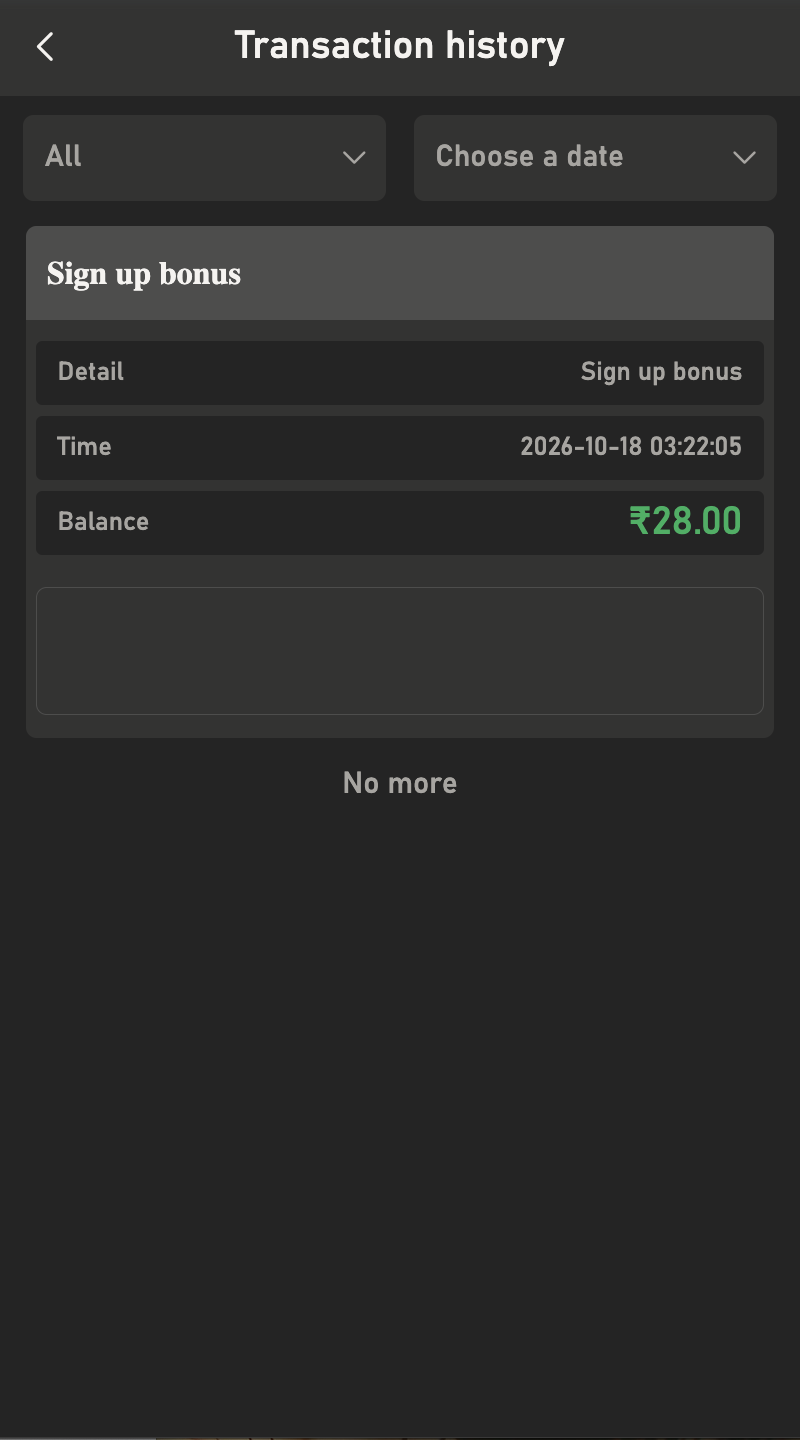
₹28 signup bonus: an account example
The account example shared with us shows a ₹28 transaction labelled “Sign up bonus”, dated 18 October 2026 at 03:22:05. The account balance also shows ₹28.
The account holder confirmed that this bonus can be used for play and cannot be withdrawn. It is bonus credit, not withdrawable cash.
This example records one account’s bonus. It does not confirm that every new account will receive ₹28. Check the current offer and eligibility terms on your account.
A bonus headline is only the start of an offer
A headline is designed to attract attention. It may describe the largest possible benefit, a limited event or a condition that applies only to some accounts. The number alone cannot tell you what a new reader will receive. A useful offer description explains who qualifies, what must happen, what the benefit consists of and which restrictions apply.
Read the words around the number. Up to is different from a fixed award. Credit is different from cash. Selected users is different from every account. An expiry date can make an old screenshot irrelevant even when the design still looks current. If the page does not explain those differences, the responsible response is to treat the claim as incomplete.
We have not verified a current BDG Win bonus amount. We do not treat an invitation link or an old promotion as a guaranteed offer. A reader should be able to distinguish a description of marketing language from a confirmed benefit. That distinction is more useful than repeating a large number without the conditions that give it meaning.
Keep invitation codes and reward promises separate
An invitation code is a referral identifier. Its presence can connect a registration to a referrer or campaign, depending on the service's own system. It does not by itself prove that a bonus exists, that you qualify for one or that a particular reward will be withdrawable. The code and the offer terms answer different questions.
Our registration link includes invitation code 4398516845588. That disclosure identifies the referral relationship; it is not evidence of a reward. The linked service controls any account process and any terms it presents. An independent publisher cannot alter those terms by using more enthusiastic button text or repeating the code across several pages.
If a page claims that a code is exclusive, mandatory or tied to a special payment, ask where that claim is documented. A code printed in an image is not proof of exclusivity. Nor does a matching code establish that a person in a chat is an authorised representative. Keep the phone number or email in context rather than treating it as a security login detail or a certificate.
Understand the different balances an account may show
An account may display several figures with different labels. A total balance might include amounts subject to restrictions. A promotional balance may have conditions attached to its use. A withdrawable figure may be calculated separately. Without the definitions, it is easy to assume that every displayed unit is equivalent to money already available in a bank.
Read the account's own explanation of each field. If two labels are unclear, ask how they relate and request a worked explanation using the service's written rules. Do not assume a balance is unrestricted simply because it is shown prominently. The visual size of a number has no bearing on its legal meaning or on the evidence of an actual transfer.
For an existing dispute, save the labels as well as the figures. A cropped number without its description can be misleading later. Record the date and any associated offer identifier. If a figure changes, preserve both versions and ask why. Keeping the terminology intact makes it easier to distinguish a calculation question from a missing payment or an account-access issue.
Read eligibility as a precise set of conditions
Eligibility should say which people or accounts an offer applies to. A claim might be limited by date, location, account status or an earlier action. Do not assume a general banner overrides restrictions elsewhere in the terms. Equally, a condition should not be invented after the event without an identifiable written basis.
Look for the effective date and the version of the terms. If the offer is time limited, note the time zone and whether the deadline concerns registration, eligibility or another event. Those are different milestones. A calendar date without a clear explanation can lead two readers to draw different conclusions even when both believe they have read the same offer.
If you need clarification, ask one question at a time: whether the offer applies to your situation, what the benefit is and where the controlling conditions are published. A vague reply such as everyone gets it does not resolve a detailed eligibility question. Keep the answer with the original wording so you can identify inconsistencies instead of relying on memory.
Conditions about use and withdrawal need separate explanations
An offer can describe when a benefit is added without explaining whether or how it can leave the account. Those are separate stages. If a promotional claim uses withdrawal language, the conditions should explain the relationship between the promotional amount, any restrictions and a transfer request. A generic statement that terms apply is not a complete explanation by itself.
Some promotions use specialised vocabulary about eligible activity, expiry or conversion. This article does not validate any such condition for BDG Win. The important reading habit is to identify the defined term and locate its exact explanation. If the definition is missing or circular, ask the responsible organisation to explain it in plain language.
Do not respond to unclear conditions by committing more money or activity in the hope that the answer will become obvious later. Uncertainty is information. An offer that cannot be understood from its written terms is not improved by urgency. If an existing balance is disputed, preserve the terms and the account record rather than trying to meet a new requirement sent by an unknown contact.
Why dated promotional screenshots can mislead
A screenshot captures what was visible at one moment. It may omit an expiry date, a footer condition or the preceding step in an account flow. Even a genuine image can become outdated. The right question is not only whether the image is real, but whether it establishes the particular claim being made today.
When reading an offer image, look for the surrounding context. Which service is named? Is the account location clear? Is there a date or campaign identifier? Can the full conditions be opened independently? A close crop can make a conditional offer appear universal. A large reward number may also belong to one person's account rather than a standard benefit.
We use images to help readers recognise terms and interface features. An image does not certify a current payment policy, guarantee an offer or establish regulatory approval. If an article and a live service differ, the relevant written terms and official legal information need to be checked. A publisher should correct an inaccurate description rather than defend it merely because an image once showed the same words.
Recognise the purpose of common game categories
Game menus can group content by theme, format or provider. A category name tells you something about presentation, but it does not necessarily explain the rules, payment structure or legal classification of each item. Two games in the same menu can have different mechanics. Two visually similar games can use different reward systems.
Common descriptions include card games, number-based games, slots, sports-themed games and arcade-style formats. These labels are broad. Before drawing conclusions, identify what the user actually does, whether anything of value is paid, what outcome is offered and how rewards are represented. A familiar name is not enough to answer those questions.
A category image is also not a safety assessment. Attractive graphics, a recognisable sporting theme or a simple interface do not establish fairness, authorisation or suitability. We do not rank money-game categories by potential profit or provide tactics to increase stakes. We explain the terms you see and what to check before relying on a claim.
Chance, skill and a money-game claim are different questions
Marketing often presents skill and chance as a simple divide. Real products can be more complicated: an activity may require decisions while also including uncertainty, and a promotional description may emphasise one part while ignoring another. A label should not be accepted as a complete account of how a game works.
For a reader, separate the mechanics from the financial claim. Mechanics concern the actions, rules and outcomes inside the game. A financial claim concerns what is paid, what might be received and whether something can be redeemed outside the game. Legal classification is another question that should be grounded in current law and official determinations rather than a slogan.
India's current framework distinguishes prohibited online money games from permissible categories such as online social games and e-sports. The official sources linked on the India page explain that framework. A publisher cannot settle a specific product's status by calling it skill based, using a sports photograph or adding an age notice. Those design choices are not a substitute for the relevant evidence.
Compare games by evidence rather than a best label
A useful comparison begins by defining what is being compared. Is it an app interface, a set of published rules, an account-support process or an entertainment format? A broad statement that one service is best usually hides several different judgements. Readers benefit more from knowing the criteria and the limits of the available information.
For interface comparisons, describe navigation, readability, accessibility and the clarity of account information. For privacy, examine the published data policy and permissions rather than guessing from the logo. For support, distinguish an advertised contact channel from a verified response to a documented issue. For payment claims, avoid treating a promotional screenshot as audited evidence of settlement.
A comparison should use the same standard for every product. It should not accept a favourable claim from one affiliate page while demanding extensive evidence from another. If information is missing, mark it as unverified. That may produce a less dramatic table, but it is more useful than a confident ranking built from unequal or outdated sources.
What a responsible comparison table should contain
A good table makes differences visible without pretending to know more than the research supports. Each row should have a clear subject and a dated source when the information can change. A cell that says not verified is preferable to a guessed fee, invented licence claim or assumed processing time. The table should also explain whether it compares brands, domains or specific apps.
Avoid combining several unnamed services into an other games column. That creates an easy opponent with no evidence behind it. If a competitor is named, verify its current public information and distinguish its official statements from independent observations. If no reliable information is available, narrow the comparison to the features you can actually describe.
Readers should also know the commercial relationship. An affiliate link can create an incentive to favour one destination, so the disclosure belongs near the relevant recommendation or link. Disclosure does not make an unsupported claim accurate, but it lets the reader understand the context. A transparent comparison explains both the evidence and the reason a link appears on the page.
Do not turn probability into an income promise
A game result cannot be inferred from the confidence of a promotional message. Words such as sure, fixed, guaranteed or recovery may suggest certainty that the underlying activity does not provide. A screenshot of a favourable result is one observation, not proof of a repeatable method. A sequence selected for advertising may omit unfavourable outcomes.
Be cautious when a person sells predictions, claims privileged access or says a loss can be recovered through a larger next attempt. Those statements need evidence beyond testimonials and edited charts. The fact that a person runs a busy channel or uses technical language does not establish that the claim is true.
We do not provide betting signals, staking systems or instructions to chase a loss. If a page about bonuses or comparisons starts to make you feel that another payment is needed to fix an earlier disappointment, pause and separate the marketing message from the facts. An unresolved account or payment issue belongs in a documented support process, not in a strategy for more activity.
Read affiliate language with the relationship in view
An affiliate publisher may receive a commercial benefit when a reader follows a referral link or completes an action under the partner's arrangement. The exact event and amount can differ between programmes. The presence of an affiliate relationship should be disclosed without implying that the publisher controls the operator's service or can guarantee the reader's outcome.
Our registration link includes an invitation code and is an affiliate link. We are independent and do not run the linked account service. We cannot promise a bonus, change the account terms or fix a balance issue.
A clear button can describe its destination without promising an unverified bonus. Likewise, an article can explain a bonus search query without claiming that a current offer exists. This is especially important when an old page continues to receive search visits after a campaign changes. Good editorial practice requires revisiting the claim, not leaving the promise in place because it attracts clicks.
Check a message before trusting a bonus claim
Start with the destination. A shortened link or forwarded message may hide the domain until it opens. A similar-looking domain can belong to a different organisation. Do not enter login details merely because the page uses familiar colours or a recognisable logo. Verify the service through a route you already know rather than through an unsolicited message.
Next examine what the sender asks you to do. A request for an OTP, password, UPI PIN, remote phone access or a payment to a personal account is not ordinary evidence of an offer. Urgency and secrecy are additional reasons to stop. A sender who insists that you must not contact your bank or consult the written terms is reducing your ability to verify the claim.
Keep a copy of a suspicious message if it relates to an existing financial issue, but avoid forwarding it widely. Forwarding can expose other people to the same destination. If you report it, use the appropriate platform reporting tools and official channels. A publisher can receive an editorial note about misleading use of its name without becoming the organisation that investigates the financial event.
How this article is kept useful over time
The most durable parts of a bonus article are the distinctions between a referral identifier, an offer, an account record and a bank transfer. Those concepts remain useful when banners change. Specific offer amounts, fees and deadlines are more fragile and need a current reliable source before publication. This article avoids filling those gaps with numbers copied from other affiliate pages.
If a reader notices an error, the helpful report includes the page address, the exact sentence and a concise explanation. Email Rohit Kumar at [email protected] for an editorial correction. Do not send an account password, identity document or full bank statement. A correction request should describe the published information, not expose private account access.
For existing payment problems, use the deposit or withdrawal article to organise the evidence. For questions about the law and geographic availability, use the India article and its official sources. For account access, use the login and registration explanations. Each page has a different purpose, so a reader can find a focused answer without having every topic repeated in every paragraph.
Check the claim against the action requested
An offer should make sense as a complete proposition. Compare the advertised benefit with the action the reader is asked to take. If the headline talks about a reward but the next message asks for a private payment, identify the missing explanation before doing anything else. The change in request is a new fact, not a minor detail.
Keep the original advertisement and the later message together if you need to question the claim. Quote the exact wording and ask which published condition connects them. Do not assume an explanation exists merely because the sender says it is standard. A clear answer should be tied to the offer rather than to pressure, secrecy or a promise that everything will become clear after the next action.
A final way to assess an offer without guessing
Put the claim into a simple sentence: a named organisation says a defined group may receive a defined benefit under stated conditions during a stated period. If you cannot complete that sentence from the written information, identify what is missing. That missing part is a question to clarify, not a detail to assume in the most favourable way.
Then distinguish evidence of an offer from evidence of delivery. A banner may show that a promise was advertised. An account entry may show a promotional amount was recorded. A bank credit may show a transfer arrived. Each supports a different conclusion. Keeping those conclusions separate protects against both exaggerated advertising and confused complaints.
Finally, consider whether the underlying activity is lawful and appropriate for your location. A readable offer is not automatically an acceptable offer, and a referral link is not permission. The purpose of understanding the terms is to make an informed assessment, including deciding not to proceed. Clear information should reduce pressure rather than turn every uncertainty into another reason to click.
Frequently asked questions
Does invitation code 4398516845588 guarantee a bonus?
No. It identifies the referral destination used by our website. A code alone does not establish a current reward, eligibility or withdrawal right.
What is the latest BDG Win bonus amount?
We have not verified a current amount. Check the actual written offer and the legal context rather than relying on an old image or an affiliate headline.
Are promotional balances the same as bank money?
No. An account balance is a service record. Its conditions and any transfer rights need to be explained separately, and a bank credit is independent evidence of a payment.
Which BDG Win game is best for profit?
We do not rank games by promised income or offer money-game strategies. It explains categories, terms and the evidence behind claims.
Does a skill label prove a game is permitted in India?
A marketing label does not establish legal classification. Use the current official framework and any relevant determination rather than relying on a slogan.
Can I report an inaccurate offer claim on this website?
Yes. Email the page address and exact wording to [email protected]. Remove private account and payment information from the message.